






EMC 解釋:EMI、測試、標準和屏蔽技術
電磁相容性 (EMC) 對於確保電子設備正常運作而不會引起或接收不必要的電磁幹擾 (EMI) 非常重要。隨著現代電子產品變得更加先進和互聯,控制電磁雜訊在電腦、智慧...
May 19
瀏覽量: 292
集成電路(IC)
接口 - 傳感器,電容式觸摸專業ICPMIC - 穩壓器 - 特殊用途PMIC - 穩壓器 - 線性穩壓器控制器PMIC - 穩壓器 - 線性+開關PMIC - 穩壓器 - 線性PMIC - 穩壓器 - 直流開關穩壓器PMIC - 穩壓器 - 直流開關控制器PMIC - 參考電壓PMIC - V / F和F / V轉換器PMIC - 熱管理PMIC - 主管PMIC - RMS到DC轉換器PMIC - 電源控制器,顯示器PMIC - 以太網供電(PoE)控制器PMIC - 電源管理 - 專業化PMIC - 配電開關,負載驅動器PMIC - PFC(功率因數校正)PMIC - OR控制器,理想二極管PMIC - 電機驅動器,控制器PMIC - 照明,鎮流器控制器PMIC - LED驅動器PMIC - 激光驅動器PMIC - 熱插拔控制器PMIC - 門驅動器PMIC - 全半橋驅動PMIC - 能量計量PMIC - 顯示驅動程序PMIC - 現行調控/管理PMIC - 電池管理PMIC - 電池充電器PMIC - 交流直流轉換器,離線切換器內存 - 控制器內存 - FPGA的配置提示記憶 - 電池記憶邏輯 - 通用總線功能邏輯 - 翻譯,電平移位器邏輯 - 專業邏輯邏輯 - 信號開關,多路復用器,解碼器邏輯 - 移位寄存器邏輯 - 奇偶校驗發生器和跳閘邏輯 - 多諧振盪器邏輯 - 鎖存器邏輯 - 門和逆變器 - 多功能,可配置邏輯 - 門和逆變器邏輯 - 觸發器邏輯 - FIFO存儲器邏輯 - 計數器,分頻器邏輯 - 比較器邏輯 - 緩衝器,驅動器,接收器,收發器線性 - 視頻處理線性 - 比較器線性 - 模擬乘法器,分頻器線性放大器 - 視頻放大器和模塊線性放大器 - 特殊用途線性放大器 - 儀表,運算放大器,緩衝器放大器線性放大器 - 音頻界面 - 錄音和播放接口 - UART(通用異步收發器)接口 - 電信界面 - 專業化接口 - 信號終結器接口 - 信號緩衝器,中繼器,分路器接口 - 序列化器,解串器接口 - 傳感器和檢測器接口接口 - 模塊接口 - 調製解調器 - IC和模塊接口 - I / O擴展器接口 - 過濾器 - 活動接口 - 編碼器,解碼器,轉換器接口 - 驅動器,接收器,收發器接口 - 直接數字合成(DDS)接口 - 控制器接口 - 編解碼器接口 - 模擬開關,多路復用器,解復用器接口 - 模擬開關 - 特殊用途嵌入式系統芯片(SoC)嵌入式PLD(可編程邏輯器件)嵌入式 - 微處理器嵌入式 - 微控制器 - 具體應用嵌入式 - 微控制器嵌入式 - 微控制器,微處理器,FPGA模塊嵌入式 - FPGA(現場可編程門陣列)與微控制器嵌入式 - FPGA(現場可編程門陣列)嵌入式 - DSP(數字信號處理器)嵌入式-CPLD(複雜的可編程邏輯設備)數據採集 - 觸摸屏控制器數據採集 - 數模轉換器(DAC)數據採集 - 數字電位器數據採集 - 模數轉換器(ADC)數據採集 - 模擬前端(AFE)數據採集 - ADC / DAC - 特殊用途時鐘/定時 - 實時時鐘時鐘/時序 - 可編程定時器和振盪器時鐘/定時 - IC電池時鐘/時序 - 延遲線時鐘/時鐘 - 時鐘發生器,PLL,頻率合成器時鐘/時序 - 時鐘緩衝器,驅動器時鐘/時序 - 具體應用音頻專用熱門品牌
More categories
分立半導體產品
當前調節 - 二極管,晶體管晶體管 - 特殊用途晶體管 - 可編程單結晶體管 - JFET晶體管 - IGBT - 單晶體管 - IGBT - 模塊晶體管 - IGBTs - 陣列晶體管 - FET,MOSFET - 單晶體管 - FET,MOSFET - RF晶體管 - FET,MOSFET - 陣列晶體管 - 雙極(BJT) - 單,預偏置晶體管 - 雙極(BJT) - 單晶體管 - 雙極(BJT) - 射頻晶體管 - 雙極(BJT) - 陣列,預偏置晶體管 - 雙極(BJT) - 陣列晶閘管 - TRIAC晶閘管 - SCR-模塊晶閘管 - SCR晶閘管 - DIAC,SIDAC電源驅動器模塊二極管 - 齊納 - 單二極管 - 齊納 - 陣列二極管 - 可變電容(靜脈曲張,變體)二極管 - 射頻二極管 - 整流器 - 單二極管 - 整流器 - 陣列二極管 - 橋式整流器熱門品牌
More categories
電容器
熱門品牌
More categories
電路保護
電視 - 電湧保護設備(SPD)TVS - 壓敏電阻,MOVTVS - 晶閘管TVS - 混合技術TVS - 二極管熱熔斷路器(熱熔斷器)浪湧抑制ICPTC可複位保險絲照明保護浪湧電流限制器(ICL)接地故障電路斷路器(GFCI)氣體放電管避雷器(GDT)保險絲保險絲盒電氣,特種保險絲斷路器熱門品牌
More categories
隔離
熱門品牌
More categories
RF / IF和RFID
訂戶標識模塊(SIM)卡RF循環器和隔離器RFID,RF接入,監控ICRFID應答器,標籤RFID讀寫器模塊RFID評估和開發套件,董事會RFID天線RFI和EMI - 屏蔽和吸收材料RFI和EMI - 觸點,指板和墊圈射頻發射機射頻收發模塊射頻收發器IC射頻開關射頻屏蔽射頻接收機射頻接收器,發射器和收發器成品單元射頻功率分配器/分離器射頻功率控制器IC射頻調製器射頻混頻器射頻雜項IC和模塊射頻前端(LNA + PA)RF評估和開發套件,董事會射頻定向耦合器射頻雙工器射頻探測器射頻解調器射頻天線射頻放大器巴倫衰減器熱門品牌
More categories
過濾器
熱門品牌
More categories
傳感器,傳感器
超聲接收器,發射器 - 工業溫度傳感器 - 恆溫器 - 機械 - 工業溫度傳感器 - 模擬和數字輸出 - 工業接近傳感器 - 工業壓力傳感器,傳感器 - 工業光學傳感器 - 光子學 - 計數器,檢測器,SPCM(單光子計數模塊)光學傳感器 - 相機模塊磁性傳感器 - 位置,接近,速度(模塊) - 工業力傳感器 - 工業流傳感器 - 工業浮點,水平傳感器 - 工業編碼者 - 工業顏色傳感器 - 工業觸摸傳感器超聲波接收器,變送器溫度傳感器 - 恆溫器 - 固態溫度傳感器 - 恆溫器 - 機械溫度傳感器 - 熱電偶,溫度探頭溫度傳感器 - RTD(電阻溫度檢測器)溫度傳感器 - PTC熱敏電阻溫度傳感器 - NTC熱敏電阻溫度傳感器 - 模擬和數字輸出應變計專業傳感器太陽能電池震動傳感器傳感器接口 - 接線座傳感器電纜 - 組件接近/佔用傳感器 - 成品單位接近傳感器壓力傳感器,傳感器位置傳感器 - 角度,線性位置測量光學傳感器 - 反射 - 邏輯輸出光學傳感器 - 反射 - 模擬輸出光電傳感器 - 光電晶體管光電傳感器 - 光電斷路器 - 插槽類型 - 晶體管輸出光學傳感器 - 光電斷路器 - 插槽類型 - 邏輯輸出光電傳感器 - 光電工業光電傳感器 - 光電二極管光傳感器 - 光電探測器 - 遙控接收器光學傳感器 - 光電探測器 - 邏輯輸出光學傳感器 - 光電探測器 - CdS電池光學傳感器 - 距離測量光傳感器 - 環境光,紅外,紫外線傳感器多功能運動傳感器 - 振動運動傳感器 - 傾斜開關運動傳感器 - 光學運動傳感器 - 傾角儀運動傳感器 - IMU(慣性測量單元)運動傳感器 - 陀螺儀運動傳感器 - 加速度計磁鐵 - 傳感器匹配磁鐵 - 多用途磁性傳感器 - 開關(固態)磁性傳感器 - 位置,接近度,速度(模塊)磁性傳感器 - 線性,指南針(IC)磁性傳感器 - 指南針,磁場(模塊)LVDT傳感器(線性可變差動變壓器)IrDA收發器模塊圖像傳感器,相機濕度,濕度傳感器氣體傳感器力傳感器流量傳感器浮子,液位傳感器編碼器防塵傳感器電流傳感器彩色傳感器放大器熱門品牌
More categories
繼電器
熱門品牌
More categories
變形金剛
熱門品牌
More categories
電阻器
熱門品牌
More categories
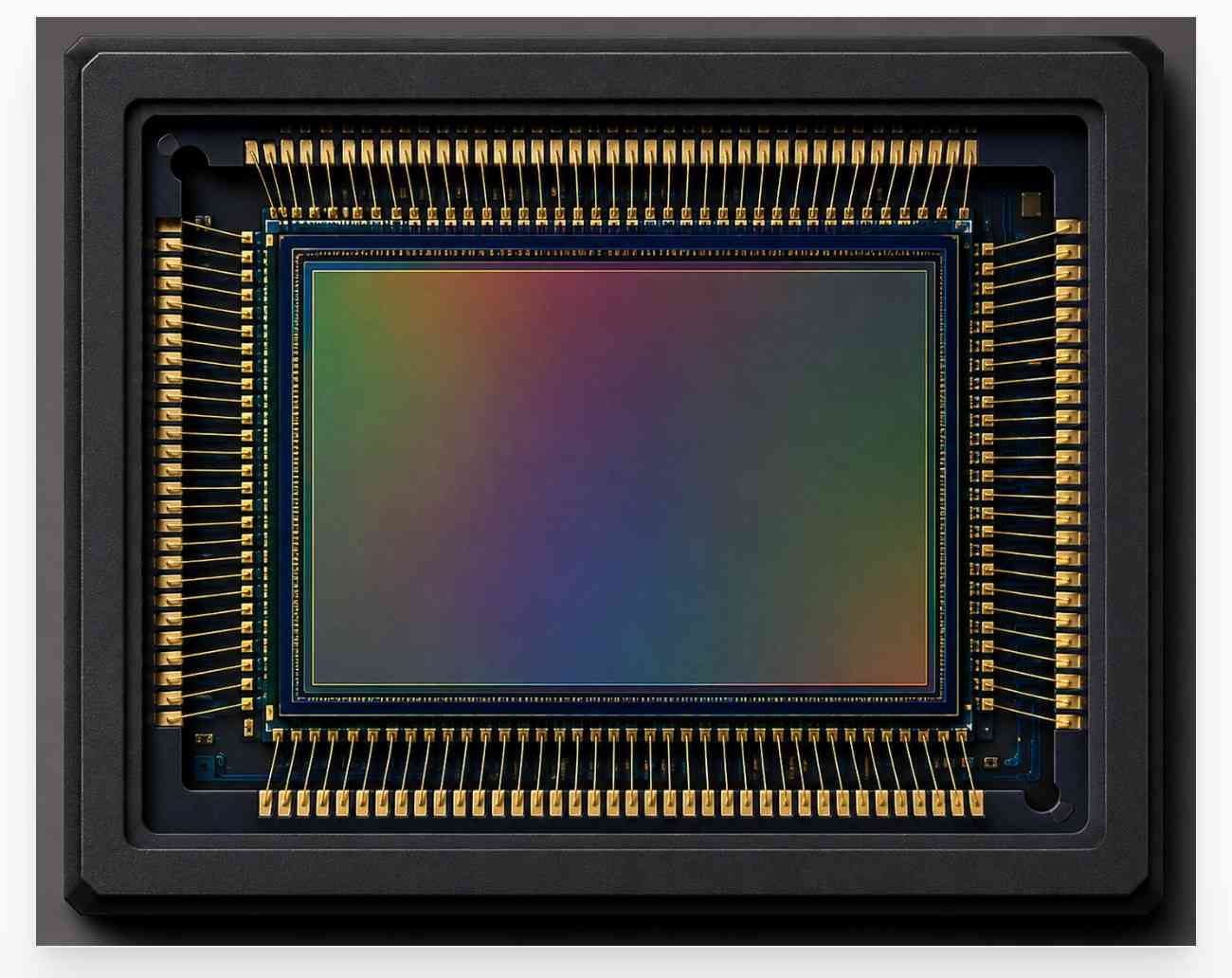
Figure 1: CMOS Sensor
A CMOS sensor is the most common type of image sensor used in digital cameras and smartphones today. CMOS stands for Complementary Metal-Oxide Semiconductor. These sensors became popular because they are fast, energy-efficient, and cheaper to produce than older CCD sensors. CMOS sensors are widely used in smartphones, mirrorless cameras, webcams, and security cameras because they provide good image quality at a lower cost.
BSI CMOS stands for Backside-Illuminated CMOS. It is an improved version of a standard CMOS sensor designed to capture more light and improve image quality. BSI CMOS sensors are especially useful for smartphone cameras because they help produce brighter images, better low-light photos, and less image noise. Because of these benefits, many modern devices from companies such as Sony and Samsung use BSI CMOS technology.
Stacked CMOS sensors are a more advanced type of CMOS sensor built for faster camera performance. These sensors can process image data much faster than standard CMOS and BSI CMOS sensors, making them useful for high-speed photography and advanced video recording. Stacked CMOS sensors are commonly used in flagship smartphones and professional cameras from brands like Canon and Nikon because they support features such as faster autofocus and smoother video capture.
A CMOS image sensor works by capturing light and turning it into a digital image. When light enters the camera lens, it reaches millions of tiny pixels called photodiodes that detect the light and convert it into electrical signals. The camera processor then changes these signals into a photo or video with color and detail. Because each pixel works separately, CMOS image sensors can process images quickly, making them widely used in smartphones, digital cameras, and security cameras.
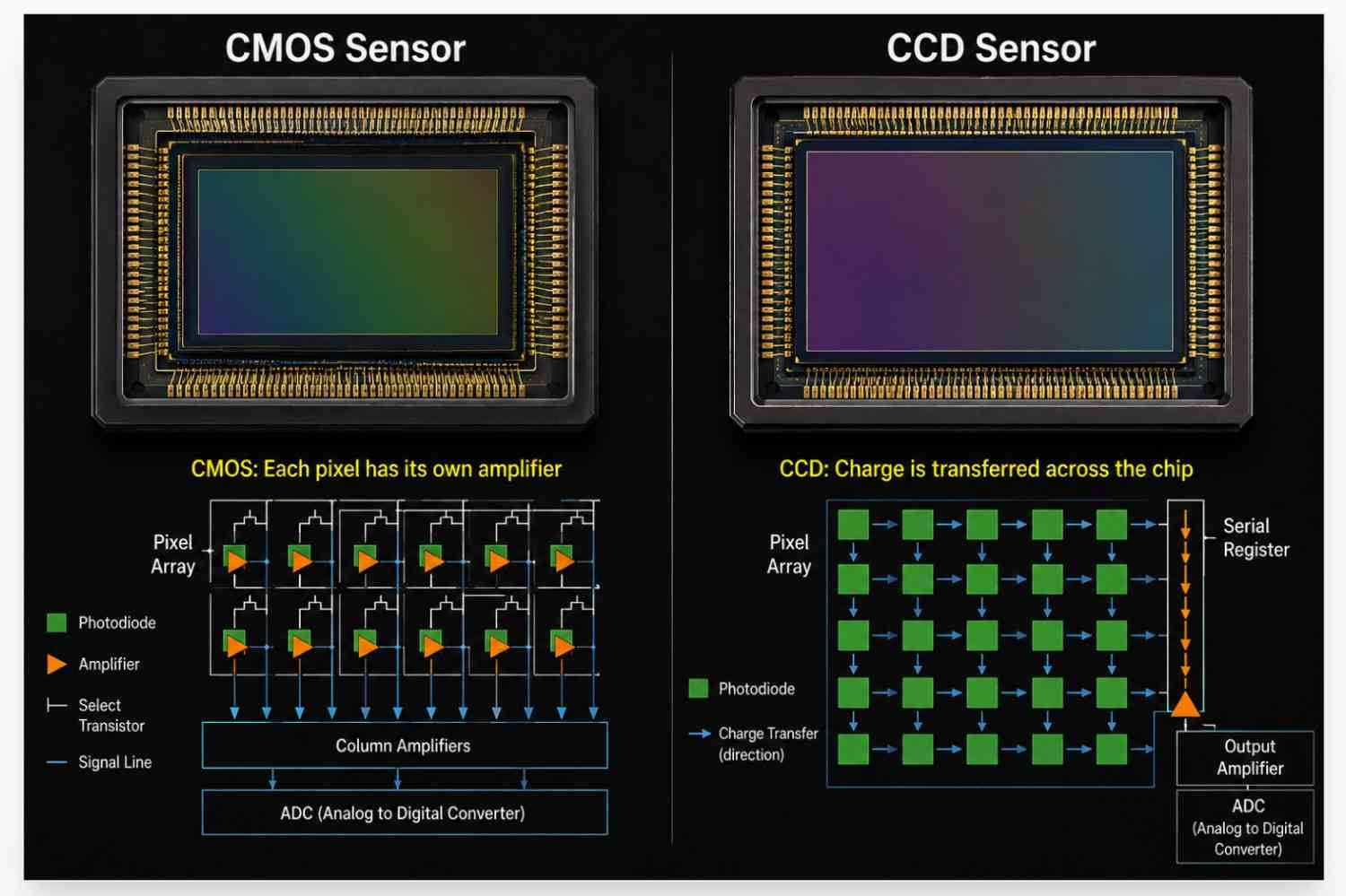
Figure 2: CMOS vs CCD Sensors
(insert table)
BSI CMOS sensors perform better in low light because they can capture more light than standard CMOS sensors. In a regular CMOS sensor, some incoming light is blocked by the wiring layer above the pixels, while a BSI CMOS sensor places the wiring behind the pixels so more light can directly reach the light-sensitive area. This improves image brightness, reduces image noise, and helps produce clearer photos in dark environments, making BSI CMOS technology widely used in modern smartphone cameras and digital cameras.
Stacked CMOS sensors are faster because they use a layered sensor design that separates image capture and signal processing into different layers. This structure allows the sensor to transfer and process image data more quickly than standard CMOS and BSI CMOS sensors. Faster data processing improves camera performance by supporting high-speed burst shooting, faster autofocus, smoother slow-motion video, and higher frame-rate video recording. Stacked CMOS sensors also reduce rolling shutter distortion because the sensor can read image data more efficiently during fast movement. Because of these advantages, stacked CMOS technology is widely used in flagship smartphones and professional cameras from companies such as Sony, Canon, and Nikon.
(insert table)
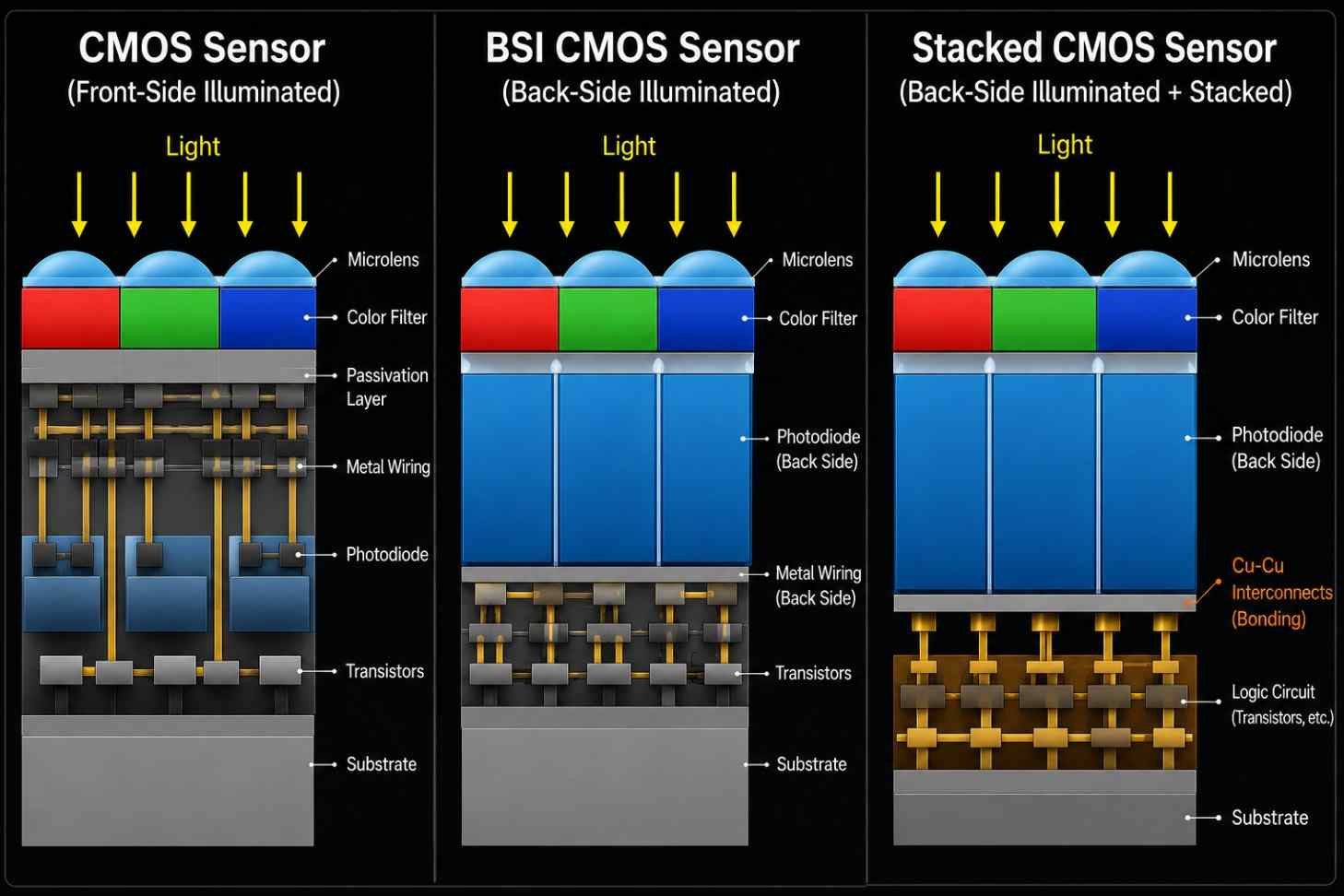
Figure 3: CMOS vs BSI CMOS vs Stacked CMOS Sensor
(insert table)
• Smartphones and budget digital cameras — Commonly used because CMOS sensors provide good image quality at a lower manufacturing cost.
• Security and surveillance cameras — Used for continuous video monitoring due to low power consumption and fast image processing.
• Webcams and laptops — Help support video calls and online meetings with efficient image capture performance.
• Automotive cameras — Used in parking cameras and driver-assistance systems for real-time imaging.
• Smartphone cameras — Improve low-light photography, night mode imaging, and HDR photo quality.
• Mirrorless and DSLR cameras — Help produce brighter images with lower image noise in dark environments.
• Security cameras — Enhance nighttime surveillance and indoor image clarity.
• Compact digital cameras — Improve image brightness and detail in portable camera systems.
• Flagship smartphones — Support faster autofocus, smoother slow-motion video, and high-speed image processing.
• Professional mirrorless cameras — Improve burst shooting speed and reduce rolling shutter effects during sports photography.
• High-speed video cameras — Enable faster sensor readout for advanced video recording and motion capture.
• Industrial and machine vision systems — Help process image data quickly for automation, robotics, and inspection systems.
CMOS, BSI CMOS, and stacked CMOS sensors each have different strengths in modern camera technology. Standard CMOS sensors are affordable and efficient, BSI CMOS sensors improve low-light image quality, and stacked CMOS sensors provide faster performance and better video capability. These sensor technologies are widely used in smartphones, digital cameras, and many modern imaging devices.
BSI CMOS sensors are commonly used in smartphone cameras because they can capture more light and produce better low-light image quality. Unlike standard CMOS sensors, BSI CMOS sensors place the wiring behind the pixels, allowing more light to directly reach the photodiodes. This improves image brightness, reduces image noise, and helps smartphones capture clearer night photos and better HDR images even with small camera sensors.
Stacked CMOS sensors are better for sports photography and high-speed video recording because they process image data much faster than standard CMOS and BSI CMOS sensors. Their layered sensor design improves sensor readout speed, allowing faster autofocus, smoother slow-motion video, and high-speed burst shooting. Faster processing also helps reduce rolling shutter distortion when capturing fast-moving subjects.
CMOS sensors are more popular than CCD sensors because they are faster, more energy-efficient, and cheaper to manufacture. Modern CMOS sensors also support advanced features such as 4K and 8K video recording, fast autofocus, and high-speed image processing. Because of these advantages, CMOS sensors are now widely used in smartphones, mirrorless cameras, DSLR cameras, and security cameras.
Rolling shutter affects video and photography performance by causing moving objects to appear bent, stretched, or distorted during fast motion. This happens because rolling shutter sensors capture images line by line instead of all at once. The effect is more noticeable in sports photography, drone footage, and fast camera movements. Faster stacked CMOS sensors help reduce this issue by improving sensor readout speed.
Stacked CMOS sensors improve autofocus performance because they can process image data more quickly than traditional sensor designs. Faster data transfer allows the camera to track moving subjects more accurately and adjust focus faster in real time. This is especially important in professional mirrorless cameras and flagship smartphones used for action photography and video recording.
Low-light performance is important because cameras are often used in dark indoor environments, nighttime photography, and low-light video recording. Sensors with better light sensitivity can capture brighter images with less noise and better detail. BSI CMOS sensors are especially useful for low-light photography because they allow more light to reach the pixels.
CMOS image sensors convert light into digital images by using millions of tiny pixels called photodiodes. When light enters the camera lens, the photodiodes detect the light and convert it into electrical signals. The camera processor then changes these signals into a digital photo or video with color and detail.
Stacked CMOS sensors are commonly used in flagship smartphones because they support advanced camera features such as faster autofocus, smoother slow-motion video, reduced rolling shutter effects, and high-speed image processing. These features improve smartphone photography and help support advanced video recording and computational photography functions.
The main differences between CMOS, BSI CMOS, and stacked CMOS sensors are their sensor structure, light sensitivity, and processing speed. Standard CMOS sensors focus on affordability and efficiency, BSI CMOS sensors improve low-light image quality, while stacked CMOS sensors provide the fastest image processing and advanced camera performance.
CMOS sensors are widely used in security and surveillance cameras because they offer fast image processing, low power consumption, and affordable manufacturing costs. These advantages allow security cameras to continuously record video efficiently while maintaining good image quality for monitoring and surveillance applications.
May 20
瀏覽量: 49
May 19
瀏覽量: 292
May 18
瀏覽量: 360
May 18
瀏覽量: 325
May 14
瀏覽量: 505
May 14
瀏覽量: 485